The 21st (Service) Battalion of the Middlesex Regiment was raised by the Mayor and Borough of Islington on 18 May 1915 as part of Kitchener's call for local communities to raise "Pals" battalions. These Islington men would serve together, fight together, and fall together across the Western Front.
Formation on Islington Green
In February 1915, Lord Kitchener approached 28 Metropolitan Borough Councils in London with a proposal: raise local battalions in which neighbours, workmates, and friends could serve side by side. Islington answered the call. On 18 May 1915, the 21st (Service) Battalion, Middlesex Regiment (Islington) officially formed, with the Mayor and Borough as its patron.
The battalion came to be known as the "Islington Pals." Lieutenant-Colonel Edward St Aubyn Wake, a retired Indian Army officer, took command on 2 June 1915. By September, the battalion had assembled at Aldershot for training, before moving to Witley Camp in Surrey that November.
The Journey to France
On 27 May 1916, the Islington Pals mobilised at Woking. They embarked from Southampton on 5 June and landed at Le Havre the following day. The battalion arrived with 33 officers and 990 other ranks. They moved first to Lillers near Béthune, then into the Calonne sector for their introduction to trench warfare.
On the Somme
The Islington Pals entered the Somme sector in late October 1916, by which time the battle that bears the river's name had already consumed tens of thousands of British lives. They took up positions at Rancourt and Maurepas, holding trenches through the winter of 1916–1917 in conditions described as destroyed and flooded.
The following spring brought movement. Between 17 and 20 March 1917, the battalion advanced into the German retreat toward the Hindenburg Line, occupying Péronne and Mont St Quentin. In April, they took Beaucamp after its capture, suffering 26 killed, 38 wounded, and one missing on 9 April alone.
Bourlon Wood and the Battle of Cambrai
On 23 November 1917, the Islington Pals fought at Bourlon Wood during the Battle of Cambrai. Advancing with the 121st Brigade to the left of the wood, C Company reached the Sunken Lane south-west of Bourlon village.
The cost was severe. Over three days, the battalion lost 3 officers and 20 other ranks killed, 8 officers and 99 other ranks wounded, and 7 missing. Lieutenant-Colonel Wilfrid Samuel, who had taken command in March 1916, later thanked his men for "upholding the traditions of the 'Die-hards'"—the nickname of the Middlesex Regiment.
The German Spring Offensive
The battalion faced its severest test between 21 and 25 March 1918 during the German Spring Offensive. Fighting at Henin Hill, St-Léger, and Ervillers, the 119th Brigade held a frontage of 4,000 yards. The Islington Pals suffered 268 casualties during the battle. Lieutenant-Colonel Herbert Metcalfe, who had assumed command in December 1917, was awarded the Distinguished Service Order. Brigadier-General Frank Crozier described him as "a stone wall when necessary, a thrusting lance when required."
Remembering the Fallen
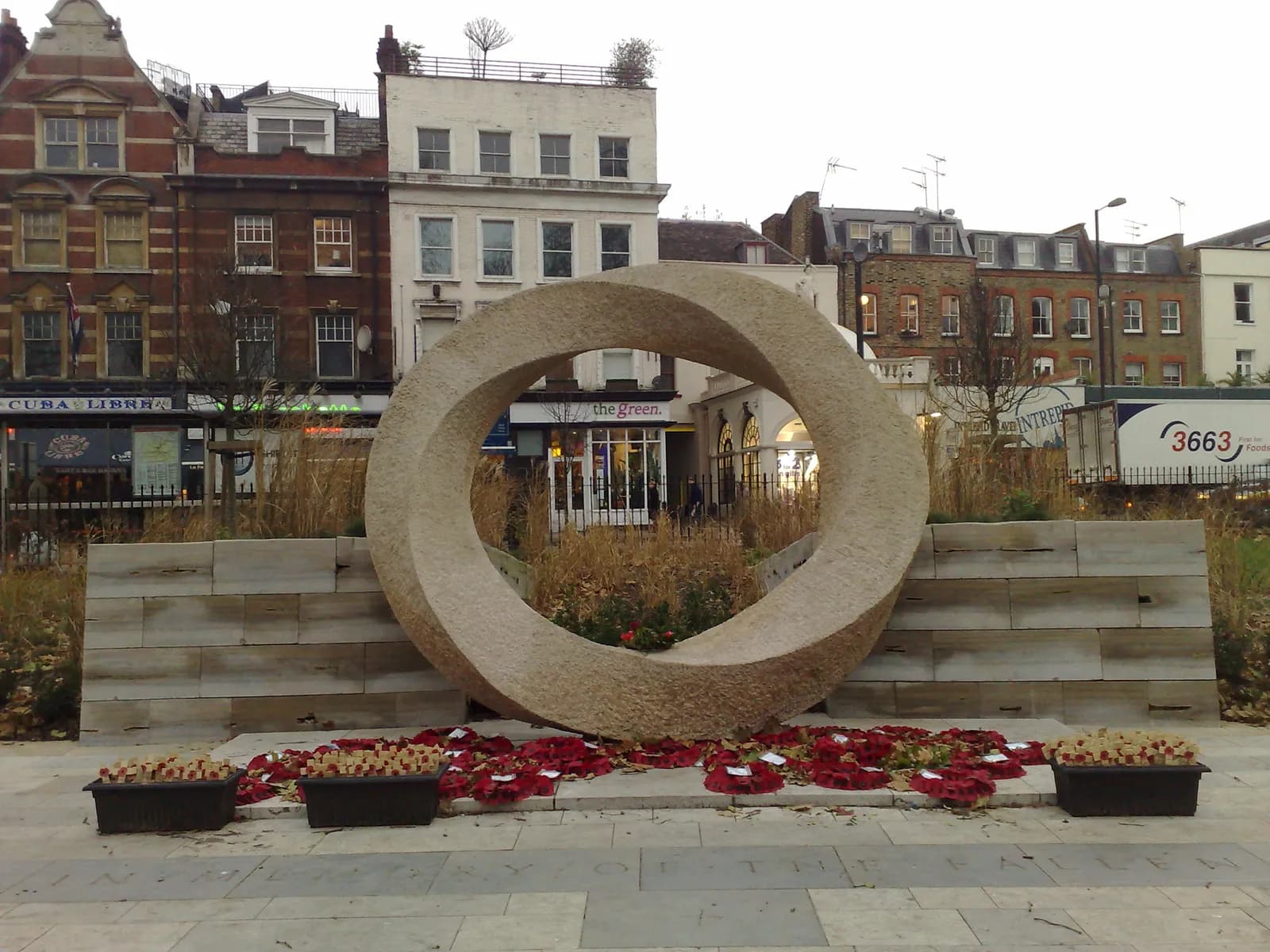
The war memorial on Islington Green stands as the borough's testament to the men who never returned. The original memorial, a painted concrete obelisk with bronze plaques, was unveiled on 26 October 1918—a full month before the Armistice—bearing the simple inscription "IN MEMORY OF THE FALLEN." It was presented by Charles Higham, a local businessman, and stood for nearly nine decades until its demolition in 2006.
The current memorial, unveiled in 2007 and designed by artist John Maine, features an eight-tonne twisted stone ring carved in Fujian province, China. Stone tablets inscribed with "LAND," "SEA," "AIR," and "HOME" flank the central wreath-like sculpture. Five Victoria Cross tablets have since been added to honour the borough's highest military decorations.
The Reserve Battalion
While the 21st Battalion fought in France, a second unit—the 28th (Reserve) Battalion—formed from the depot companies of the Islington and Shoreditch Pals. Based initially at Shoreditch, then Northampton from December 1915, and later Aldershot, this battalion trained reinforcement drafts to replace the steady stream of casualties from the front.
From Local Men to Lasting Legacy
The Islington Pals were disbanded on 14 December 1918, seven weeks after the Armistice. The battalion had served for three years and seven months, carrying the name of their borough into some of the war's most notorious engagements. The Imperial War Museum's records note that total casualty figures for the battalion's entire service remain incomplete in publicly accessible sources; local archives may hold fuller records of the human cost to Islington families.