Four centuries after its completion, a Welsh goldsmith's audacious engineering project continues to supply London with fresh water. Much of it now runs unseen beneath Islington's streets, but traces of Sir Hugh Myddelton's creation remain visible to those who know where to look.
The Man Who Brought Water to London
Sir Hugh Myddelton was born in 1560 at Galch Hill in Denbighshire, Wales. A clothmaker, entrepreneur, mine-owner, and self-taught engineer, he had already made his fortune as Royal Jeweller to King James I when he turned his attention to one of London's most pressing problems: clean water.
The idea for a new water supply had originally been proposed in 1602 by Edmund Colthurst, who obtained a charter from King James I in 1604. When Colthurst encountered financial difficulties, Myddelton took over the project in March 1609. What followed was one of the most ambitious engineering feats of the age.
Four Years, Forty Miles
The New River was neither new nor a river in the conventional sense. It was a forty-mile artificial waterway, opened on 29 September 1613, that carried water from springs at Chadwell and Amwell near Ware in Hertfordshire all the way to a terminus at what is now New River Head in Clerkenwell and Islington.
The construction was remarkable for its precision. Engineers maintained a gradient of just five inches per mile, allowing water to flow by gravity alone across the Hertfordshire countryside, through Middlesex, and into London. The project nearly bankrupted Myddelton; in 1612, King James I stepped in to take half the shares in exchange for half the profits.
Myddelton served as the first Governor of the New River Company, incorporated by royal charter in 1619. The company would operate for nearly three centuries, making it one of the earliest joint-stock utility companies in existence.
Islington: The River's Destination
The New River's original terminus was at New River Head, on land now bounded by Rosebery Avenue, Hardwick Street, Amwell Street, and Myddelton Passage. Here stood the Round Pond, a circular reservoir two hundred feet in diameter, lined with oak and encircled by a brick security wall. The adjacent Water House, built in 1613, served first as a cistern house and later as company headquarters.
The route through Islington took the river to the east of Upper Street, where the land was well-suited to market gardens in the seventeenth and eighteenth centuries. In 1708, an Upper Pond was constructed at Claremont Square to improve water pressure to the West End.
Myddelton's Name in Islington Stone
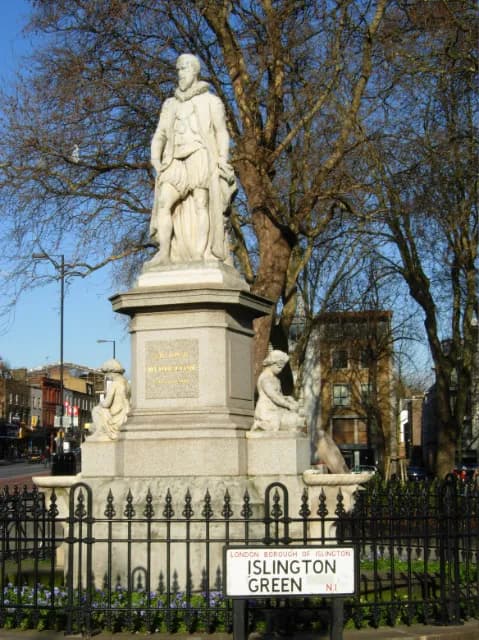
Myddelton's contribution is commemorated throughout the borough. A Grade II listed statue by sculptor John Thomas stands on Islington Green, unveiled in 1862 by William Gladstone. Carved from Sicilian marble and mounted on a granite plinth, the statue portrays Myddelton holding a rolled plan of his river.
His name survives in the streetscape: Myddelton Square, Myddelton Street, and Myddelton Passage all honour the Welsh engineer. Hugh Myddelton Primary School bears his name, as did the Myddelton Arms pub on New North Road in Canonbury.
Still Flowing, Mostly Underground
The New River remains operational today, though its route has changed. In March 1946, the last filter beds at New River Head were decommissioned, and the section south of Stoke Newington was abandoned. The river now terminates at the East Reservoir in Stoke Newington, having been truncated to a twenty-mile course.
Thames Water, successor to the New River Company and the Metropolitan Water Board, maintains the waterway. It still carries approximately 220 million litres of water daily, accounting for roughly eight per cent of London's total use.
Traces of the original route remain visible in Islington. The New River Walk, a linear park between Canonbury and the town centre, follows the redundant section along Colebrooke Row and Duncan Terrace. White boulders mark the course between Balls Pond Road and Essex Road. Elsewhere, the former path can be seen in gaps in the urban fabric along Petherton Road, through Canonbury, and along Astey's Row.
A Site of Continuous Water History
New River Head itself has evolved with London's water needs. After serving as headquarters for the Metropolitan Water Board from 1913 to 1987, the site was converted to residential use. Its surviving industrial buildings, including the Engine House and the base of a windmill, are Grade II listed and are being restored for the Quentin Blake Centre for Illustration, due to open in 2026.
A pumping station installed between 1986 and 1994 now serves the London Water Ring Main, continuing the site's four-hundred-year association with the capital's water supply. Interpretative panels in the public viewing area tell the story of this remarkable place.
Sir Hugh Myddelton died on 10 December 1631, aged seventy-one, and was buried at St Matthew Friday Street in the City. He was created a baronet in 1622, and his brother Thomas served as Lord Mayor of London. But his most enduring legacy flows quietly beneath the streets of Islington, still serving the city he helped to build.